The Anatomy of a Seal Failure: Why Flexible Packages Fail at the Seam
In the flexible packaging industry, the most advanced, high-barrier multilayer film on the market is completely useless if it cannot form a reliable seal. A seal failure compromises product freshness, shortens shelf life, and often leads to costly retail returns and severe brand damage.
When a package fails at the seam, the root cause is rarely obvious to the naked eye. Diagnosing the issue requires a deep dive into the mechanics of the sealing process and the molecular behavior of the film. Here is an anatomical breakdown of why flexible packages fail at the seam, and how to prevent it.
1. Heat Seals vs. Cold Seals: Different Mechanisms, Different Failures
The first step in diagnosing a seal failure is understanding the sealing mechanism itself:
- Heat Sealing: The most common method, relying on temperature, pressure, and time to melt a specialized sealant layer (often polyethylene or a specialized ionomer) so the polymer chains entangle and fuse together.
- Cold Sealing: Used for temperature-sensitive products like chocolate bars or ice cream. This relies on a cohesive coating applied to the film that bonds only to itself under mechanical pressure, without the need for heat.
While cold seals typically fail due to inadequate pressure, misaligned webs, or aged/degraded cohesive coatings, heat seals are far more complex and prone to a wider variety of failure modes.
2. The “Golden Triangle” Imbalance: Time, Temperature, and Pressure
A successful heat seal requires a perfect balance of three variables on the packaging line. If any one of these is off, the seal will fail:
- Inadequate Temperature: If the sealing jaw is too cold, the polymer does not reach its Seal Initiation Temperature (SIT). The layers won’t melt enough to entangle, resulting in a weak, peelable seal that pops open under stress.
- Excessive Temperature: Conversely, if the jaw is too hot, it can scorch the film or cause the sealant to flow completely out of the seal area. This creates a brittle seam that easily snaps or tears.
- Improper Dwell Time: Dwell time is the fraction of a second the heated jaws clamp down on the film. High-speed packaging lines often push dwell times to their absolute limits. If the jaws open before the heat has time to penetrate through the outer layers to the sealant web, the seal will be critically weak.
- Uneven Pressure: If the sealing jaws are misaligned or worn, they will apply uneven pressure. This creates “channel leaks”—microscopic tunnels through the seal where oxygen and moisture can freely enter the package.
3. Seal Area Contamination
Even if your temperature, time, and pressure are perfectly calibrated, a seal will fail if the area is contaminated before the jaws close. During the filling process, product dust, powders, oils, or liquids can splash onto the seal zone.
When the jaws clamp down on these contaminants, they act as a physical barrier that prevents the polymer chains from fusing. In applications like dusty powdered mixes or oily meat packaging, engineers must select specialized sealant resins (like metallocenes or Surlyn) designed to flow around and seal through contamination.
4. Delamination and Structural Failures
Sometimes, a package appears to have a seal failure, but the root cause is actually a structural failure within the film itself. If the bond strength between the various laminated layers of the film is weaker than the seal strength, the package will suffer from delamination.
In this scenario, the heat seal holds perfectly, but the inner sealant layer violently peels away from the outer barrier layer, exposing the product to the environment. This often points to an issue during the lamination or extrusion coating process rather than a problem on the filling line.
How Flex-Pack Engineering Can Help
Diagnosing a seal failure should not be a game of trial and error on your high-speed production line. When you are losing thousands of dollars an hour to line downtime or product spoilage, you need definitive answers.
Flex-Pack Engineering provides the unbiased, expert analytical testing required to identify the exact root cause of a seal failure. Our state-of-the-art laboratory is equipped to perform:
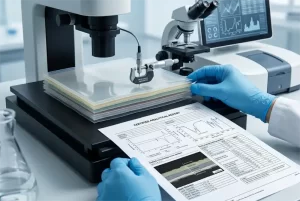
- Optical Microscopy: To visually inspect seal cross-sections, measure channel leaks, and identify uneven polymer flow.
- FTIR (Fourier Transform Infrared Spectroscopy): To detect microscopic contaminants—like oils or starches—that may be preventing a proper bond.
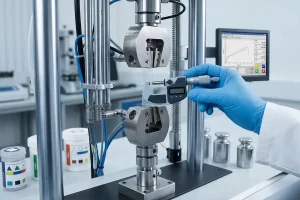
- Tensile and Bond Strength Testing: To evaluate peel strength, identify delamination issues, and ensure your film is performing to specification.
We don’t just give you raw data; we interpret the results and provide actionable engineering solutions to fix your sealing issues for good.
Stop wrestling with unexplained seal failures. Contact Flex-Pack Engineering today at 888-300-1482 to partner with the experts in flexible packaging validation.