Blown vs. Cast Film: A Comparative Guide to Extrusion Processes
When designing a flexible packaging structure, the polymers you choose are only half the equation. How those polymers are melted, shaped, and cooled during the extrusion process fundamentally alters the physical and optical properties of the final film. In the flexible packaging industry, the two dominant manufacturing methods are blown film extrusion and cast film extrusion.
A common question we hear from procurement and engineering teams is: “Which process is better?” The truth is, neither is universally superior. The right choice depends entirely on your product’s specific Fitness for Use (FFU) requirements—particularly when balancing barrier needs against clarity and mechanical strength.
Cast Film: The Champion of Clarity and Speed
In the cast film process, molten polymer is extruded through a flat die onto a highly polished, water-cooled chill roll. This rapid quenching (cooling) process prevents the polymers from forming large crystals.
Where Cast Film Excels:
- Optical Clarity: Because of the rapid cooling, cast films offer exceptional transparency, high gloss, and low haze. If your marketing team demands a crystal-clear window so consumers can see the product, cast is typically the way to go.
- Gauge Consistency: The cast process allows for highly precise control over film thickness (gauge), minimizing variations across the web.
- High-Speed Production: Cast extrusion lines generally run faster than blown lines, making it a highly efficient process for high-volume applications.
The Trade-off: Cast films are stretched primarily in one direction (the machine direction). This makes them highly susceptible to tearing in the machine direction and generally less puncture-resistant than their blown counterparts.
Blown Film: The Powerhouse of Strength and Barrier
In blown film extrusion, the molten polymer is pushed through a circular die to form a continuous tube. Air is blown into the center of the tube, inflating it like a balloon (the “bubble”), while air rings cool the outside. The bubble is drawn upward, stretching the film both vertically and horizontally before it is collapsed and wound into rolls.
Where Blown Film Excels:
- Mechanical Strength: Because the film is stretched in two directions (biaxial orientation), it develops incredible toughness, tear resistance, and puncture resistance. It is the go-to choice for heavy-duty applications like frozen food bags, agricultural films, and industrial packaging.
- Barrier Integrity: The biaxial stretching and slower cooling process can enhance the barrier properties of certain polymers, making blown film ideal for high-barrier coextrusions requiring strict Oxygen Transmission Rate (OTR) or Moisture Vapor Transmission Rate (MVTR) control.
- Flexibility in Width: By adjusting the volume of air inside the bubble, manufacturers can easily change the width and thickness of the film without changing the die.
The Trade-off: The slower, air-cooled process allows larger polymer crystals to form, resulting in a film that is inherently hazier and less glossy than cast film. Gauge control is also slightly less precise compared to the cast process.
The Showdown: Making the Right Choice
- Choose Cast Film if your primary requirements are optical clarity, high gloss, uniform thickness, and lower-stress applications (e.g., bread bags, clear overwrap, stretch film).
- Choose Blown Film if your primary requirements are aggressive puncture resistance, superior tear strength, and rugged barrier performance (e.g., stand-up pouches for sharp or heavy foods, frozen packaging, heavy-duty sacks).
How Flex-Pack Engineering Can Help
Selecting between blown and cast film—or deciding if a complex coextrusion is necessary—should never be based on guesswork or biased supplier recommendations. It requires empirical data and a deep understanding of your packaging’s entire lifecycle.
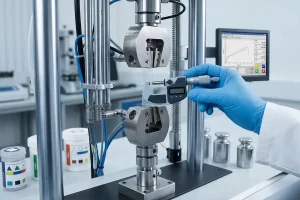
At Flex-Pack Engineering, we provide the unbiased, third-party analytical and physical testing needed to validate your film structures. Whether you are experiencing unexpected tear failures, battling a hazy film that is hurting your brand’s shelf appeal, or trying to reverse-engineer a competitor’s high-performing pouch, our laboratory can help.
Through advanced testing protocols—including OTR/MVTR analysis, Differential Scanning Calorimetry (DSC), and Optical Microscopy—we can deconstruct your packaging, identify the extrusion method used, and recommend the optimal structure for your Fitness for Use (FFU).
Stop leaving your packaging performance to chance. Contact Flex-Pack Engineering today at 888-300-1482 to optimize your flexible films.